Showing posts with label 6. Show all posts

Rhapsody at 6 Months

Welcome Rhapsody to the ranks of the Newly Salted! Read this interview as originally posted on their blog.

---

Newly Salted is a website that posts interviews of cruisers that have been cruising for less than two years. I read all of these interviews before we started cruising, and dreamt of the time when I could be a part of this project. Now we have officially been cruising for 6 months and I am excited to be able to participate.

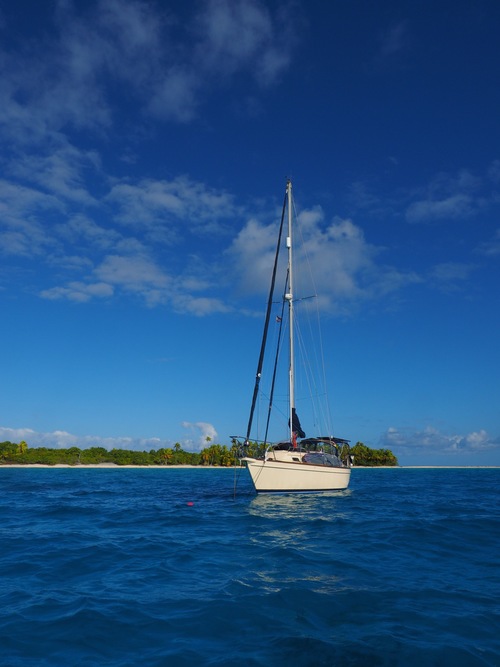
A little about us: We are Bob and Sarah aboard Rhapsody, our 49' Jeanneau Sun Odyssey. We sold off our belongings in Oregon and began cruising in November of 2016. We bought Rhapsody in the BVI and that is where we began our journey through the Caribbean. You can follow our story at rhapsodyontheblue.com

What do you find the most exciting about your cruising life?
Sarah- We got into cruising as a way to travel and have our own bed with us, so the travel and seeing new countries is what I find the most exciting.  Meeting people along the way, the quick friendships that form, and getting to do it all with my best friend. I like being able to move to a new place on a whim, or stay put if we find somewhere that we really like.

What is something that you think potential cruisers are afraid of that they shouldn't fear? And what is something potential cruisers don't worry about that perhaps they should? 
Bob- Cruisers should not worry about the details of breaking free and beginning cruising. They should focus on the wonderful opportunity before them and remember that the overall experience will be worth it.  Don't sweat the small things, get away from the dock.
They should worry about knowing their boat, having enough information to stay ahead of repairs with the right maintenance first. This will keep you safer and happier. If you know your boat you will have less to worry about.

What is something that you read or heard about cruising that you found to be particularly accurate? 
Sarah - Don't make schedules. We learned this the hard way. We agreed to meet my brother in Martinique in March.  We made plans with him in January while we were still in the BVI, thinking that we would have plenty of time. We ended up going through countries much faster than we would have liked, leaving friends behind us in our wake. The flip side of this is that we were able to get a taste of the countries to whet our appetites for further exploration. Part of the beauty of cruising is that we can come back. As for friends, we are meeting more people, and have hopes that friends that we have made will catch up with us now that we have slowed down again.

What is something that you were dreading about cruising when you were dreaming that is as bad or worse than imagined?
Bob - Loud music from the beach. Bass pounding, large speakers aimed out at the anchorage, vibrating the hull until 3 AM.

Tell me your favorite thing about your boat.
Sarah- On a day to day basis I love the space that we have. The salon and the cockpit are both spacious and very comfortable to be in. On passage I love the feeling of safety that I get. Rhapsody is a strong boat and I am sure that she can handle much bigger seas and worse weather than I can.

Share a piece of cruising etiquette. 
Bob - Anchor as far as is reasonably possible from the surrounding boats while recognizing that besides added safety many of us prefer a little privacy. If we can hold a conversation with you from our boat to yours in normal tones, you are too close.

What is something that you read or heard about cruising that you didn't find to be true?
Bob - We had heard that we might need to budget $300 - $500 a month for Customs, Immigration and various fees for checking in and out of countries. We have found that checking in and out of countries from Puerto Rico to Grenada has not at any point been particularly difficult nor expensive. We probably have spent about $150 on this in 6 months.

What do you dislike about cruising that surprised you?
Sarah - Rolly anchorages.  We did a lot of research about cruising before we started,  and I even read solutions that people had for stopping the rolling,  but all my research was done on land or in calm anchorages so somehow it didn't really sink in how it would feel. We have been fortunate to have experienced only a few really rolly anchorages, but that left enough of an impression that we avoid them whenever possible.

What is the key to making the cruising life enjoyable? 
Bob - A take-it-easy attitude combined with the right focus to keep the boat maintained, but most of all, a willing partner.

What are your plans now?
Sarah - One other thing that we have learned is the saying "a cruiser's plans are written in the sand at low tide". We have experienced this often as weather, health and friends can quickly change whatever plans we had carefully crafted. Our big picture "plan" is to spend the summer hurricane season in Grenada, possibly exploring Trinidad and/or Tobago. Early in the fall we would like to head to Bonaire to go diving and then in November head north to Puerto Rico to begin the loop again, slowing down for the parts we missed on the first go round. 

Unless something else comes up.

Final thoughts
Sarah -  As I am re-reading our answers there seems to be more negativity than we feel in reality. Rolly anchorages,  loud music, rushing for schedules. The truth is, we are really enjoying this lifestyle. The freedom to go where we want to go, the wonderful people we are meeting, and new places we are experiencing.  I am sitting in the cockpit, looking out at the turquoise waters surrounding the green islands with white sand beaches and I have a big smile on my face. Our intention is to keep doing this until it is no longer fun, and we are firmly ensconced in the fun zone now.

Posted on Wednesday, May 17, 2017 by  and tagged   |  

Helio at 6 months

Welcome Helios! Read this interview as originally published on their blog.
----------------------------------------------


[Newly Salted is a blog Dominic and I found beyond useful as we prepared for our departure. They interview sailors who are six months underway. We took their survey, and hope our experiences are helpful to others!]

 Our Background: We are Dominic and Corinne Dolci, two longtime sailors from the San Francisco Bay. We have been cruising in our Island Packet 380, Helios, since January of 2015, enjoying the California coast, Ensenada, and French Polynesia as we journey to New Zealand. You can follow our adventures at www.svhelios.com.

1. As you started cruising, what transitions did you find the most difficult?

Sleeping in shifts while underway is rough. It's the one part of cruising we couldn't prepare for without actually cutting the dock lines, and both of us put huge value on sleeping an eight-hour night.

We've built a routine that works for us—Dominic is on watch from 8 pm to 12 am, I do the graveyard shift, and Dominic takes over again at 4 am, dozing if conditions allow, and taking a proper nap in the early afternoon—but we're both left feeling groggy, and I'm not convinced that Dominic is as able to really deeply sleep at all while Helios is underway.

We maintain a ban on alarm clocks in all other circumstances, so we manage to tough it out.

I've also never lived more than 30 miles from my family, so for me, not being able to have lunch or do yoga with my mom, hike with my brother, or make dinner with my dad on a weekly basis has been a huge, difficult life change.

2. What is the best cruising advice you've heard?

The sailing advice we live by: never enter an anchorage at night.

The best adventure advice I've heard: travel like you know you're going to return.

But there are a handful axioms we find ourselves often repeating: all plans are written in the sand at low tide; a quiet boat is a happy boat; red sky at night, sailor's delight; it's five o'clock somewhere...

3. What mistakes did you make as you started cruising?

We were lucky to have a lot of cruisers supporting us as we prepared for departure (living in a marina for 16 months before departure was invaluable on this front). They're still close friends, meaning if we find ourselves at a crossroads, we can send an email via the satellite phone and have a variety of experienced opinions in the next few hours. It's awesome.

There are things we've learned by doing (no wine for me on overnight passages, wipe down the bright work and stainless after every passages, tune in to the SSB nets regularly) and different choices we would make with the benefit of hindsight (getting a long-stay visa in French Polynesia), but neither of us can think of anything we'd really call a mistake.

4. What do you like the most about your cruising life?

Getting to have a relaxed morning, just about every morning. We sleep in, drink coffee, make a delicious breakfast, consider the day. Sometimes the morning is followed by chores, other times followed by killer sailing, fantastic scenery and magnificent wildlife. We spend the days together, at our own pace, and it's a beautiful thing.

It's also thrilling, to be out cruising, not knowing where you'll be in a week, or what adventure is swimming toward you.

What they say when comparing cruising to landlubbing life is true: the highs are higher, but the lows are lower. Sometimes it's raining and you're lugging groceries around town or cleaning out the icebox while your sister is getting married half way around the world and you're missing it.

The best frame of mind I've found is to consider that cruising isn't a vacation; it's a lifestyle choice, with ups and downs like any other.

5. What do you dislike about cruising that surprised you?

I miss the food from home more than I thought I would. We've found a few tasty meals here and there, but there's a reason the tropics aren't known for their cuisine. We can usually find groceries and make ourselves delicious meals, but we're spoiled foodies from the Bay Area, and it shows.

It's also tough to have to pace our own adventure. We often find our selves in gorgeous anchorages where we want to stay longer, but our visas are limited and we have to be in New Zealand by a certain date, or a weather window opens and we have to move on. This is a challenge in most travel scenarios, but it's a series of choices we face all the time, and decision fatigue is real.

6. Is there something you wish you had bought or installed before starting out?

Dominic's wish list revolves around our energy consumption. We have 700 watts of solar power, but he would have a wind generator and a larger battery bank.

It would also be nice to have a more reliable dinghy. We have a soft-bottom Zodiac that came with the boat, and it's been chronically leaking despite multiple repairs. It takes a lot of abuse (getting pulled up on to the beach, tethered to questionable docks) and is still doing its job, but it would be nice to not have to worry about it sinking.

7. What piece(s) of gear would you leave on the dock next time? Why?

We have a lot of blankets we don't use and clothing we don't wear. We have pieces of gear we haven't yet had the chance to install: our BBQ, a drogue kit, some fancy speakers for the cockpit. We have the storage space, so they're not too cumbersome. And who knows...maybe we'll get around to it.

8. What pieces of gear do you find the most valuable?

Our satellite phone, solar panels, and water maker are our favorite luxury items. I say a prayer of gratitude everyday I wake up and don't have to lug fresh water back to the boat. With only the two of us as crew, we consider the autopilot to be absolutely invaluable—to the point that we have a second autopilot stowed away in case of emergencies.

9. How did you finance your trip?

Our trip was five years in the making, so we were able to spend that time saving and living on the cheap: we had dual incomes and no kids; we lived in the East Bay instead of San Francisco; as we got closer and closer to departure, traveling became less frequent, as did nights out on the town. We chose to live aboard for over a year prior to departure, allowing us to purchase a high quality vessel that will hopefully hold her value when we put her on the market in Australia.

10. What are your plans now? If they do not include cruising, tell us why.

Our plans are to spend the 2015-16 cyclone season in New Zealand. We'll spend next summer cruising Fiji and Vanuatu, and then move on to New Caledonia and Australia. We'll likely cruise Australia while our funds last, sell the boat, and return to life in Northern California (so we can refill the sailing kitty and start planning the adventures of Helios II).
Posted on Monday, August 31, 2015 by  and tagged   |  

Kintala at 6 months

Welcome Kintala to Newly Salted! Read this interview as originally published on their blog.
----------------------------------------------
For those of you who might not know us, we're Tim and Deb of the Tartan 42 Kintalaand of The Retirement Project site. After nearly 7 years of planning, of which 4 years was on a learner boat and 3 years refitting our current cruiser, we cut the dock lines on October 19th of 2013. We decided to go cruising for two major reasons: because we wanted to retire early and we didn't have sufficient funds to do that in a land-based retirement, and because we've been becoming increasingly disenchanted with the political and economical status quo in the US. 

Today is our 6 month anniversary so it seemed appropriate to review and evaluate. Having used both the Interview With a Cruiser and Newly Salted sites for some of our pre-departure knowledge, we thought it particularly appropriate to use that venue for our evaluation. We are deeply grateful to everyone who contributed to our preparation. Websites, blogs, friends, all became an intimate part of our readiness. Hopefully we have paid it forward to those who are still stuck in cubicle land and dreaming. We're here to say that the dream is definitely worth pursuing.

Is there something you wish you had bought or installed before starting cruising?

Deb: Solar Panels. Since Tim's company closed his department before we were quite done with the boat, some things had to wait due to limited funds and the solar panels was one of them. We do OK with the Honda generator, but it would be nice to have a quiet source of power that would allow sitting in the cockpit without the generator noise. Don't get me wrong – as far as generators go, the Honda is the best and the quietest, but I'd still rather have less noise.

Tim: Inverter and WiFi extender. Being “off the grid” is better when it is a choice of just hitting the “off” switch and using “cruising” as the excuse for not bothering with email.

How often have you faced bad weather in your cruising? How bad?

Deb: We've had a couple days of 5+ft waves and not quite 30 knots of wind which isn't much, but it's still more than I would like to have on a routine basis. Most of our bad experiences have been due to a lack of planning.

Tim: We have tried to be very conservative with weather so “bad” is a relative term. Still, as careful as we try to be we have taken a couple of serious poundings to windward with apparent winds of 30+ knots in steep and short period waves. Weather forecasting is often not specific or detailed enough to know exactly what is lurking “out there”. Two similar weather forecasts can lead to two very different experiences depending on the direction of the boat, the sail set, and just the emotional state of the crew at that particular moment. Also, turning around (except for bailing out of a Gulf Stream passage early) is usually not much of an option. Once gone one simply has to take whatever weather comes along. For us it has often been worse than expected.

What is something that you read or heard about cruising, that you didn’t find to be true?

Deb: I was worried about the culture of excess drinking. We drink, but not as much as a lot of people, and never to the point of being drunk. I was worried that we wouldn't fit in if we didn't drink as much as everyone else. We haven't been to any of the big hotspots yet like Georgetown or Marathon which might be different, but so far I've found the cruisers we've met to be careful, attentive, dedicated sailors that limit their intake. In six months I have yet to see a drunk cruiser.

Tim: This is not, ultimately, a more relaxed way to live than on land. It can be some of the time, but one is very exposed to the weather on a boat. Wind and rain barely noticed on land will make for long days on the water, and even longer nights. Everything takes more effort, shopping, laundry, routine maintenance, launching the dink, keeping track of consumables. Cruisers don't often work for anyone else, but keeping this little floating house livable is a full time job.

What piece(s) of gear would you leave on the dock next time? Why?

Deb: The SSB. We bought a used one from a friend but it will never be installed. It's a very large and complex piece of equipment that would require major installation dollars on our boat and everyone I know who owns one has a terrible time with it. We will be buying a small, portable SSB receiver so we can listen to the weather and do weather faxes. With the new HF Weather Fax app on the iPad, and the Delorme InReach for emergency communication, we just don't see any reason to have it on the boat.

Tim: We brought too many sails (6) and have yet to make a sail change. A perfect rig to me would be jib and stay sail on rollers, a main with 3 reef points (We only have two.) and a bullet proof storm stay sail that would go over the inner stay sail. 

What do you dislike about cruising that surprised you?

Deb: I've been struggling with seasickness a lot more than I expected. Our boat rolls a lot at anchorages and that pendulum motion just does me in. I never get nauseated, I'm just tired and have a headache and feel dizzy a lot. 

Tim: A lack of creature comforts; a comfortable chair, an occasional movie on a big screen, a bit of AC once in a while. Some heat now and then would sure be nice as well.

What is something that you read or heard about cruising, that you found particularly accurate?

Deb: That you will motor more than you think. We still motor way less than most people because we're rarely in a hurry to get anywhere but we motored almost the whole way down the ICW which I hated.

Tim: Cruisers spend way more time sitting still than we do moving.

What gear do you love the most?

Deb: Our iPads hands down. We use the for our primary navigation with both the Garmin Bluechart Mobile and the Navionics apps on both iPads. We also have Sailgrib and Weather Bug and Marine Weather on both of them. We keep one in the cockpit and the other one plugged in charging at all times. We still have the chart plotter on the helm, a GPS down below, and backup GPS navigation on both our phones as well as on both our laptops. A very close tie for best gear though is our Honda generator. It's our main source of charging and we simply love it!

Tim: Navigation on iPads.

Tell me your favorite and least favorite thing about your boat.

Deb: My favorite thing is the way the light plays off the teak inside in the morning sunshine. I love the inside of our boat. It feels like our home, something that's important to me since it's our full time home. I also love my galley. It fits me and everything is in the right place (bet you don't hear that often!) My least favorite is the cockpit. Our boat has a very narrow stern which is a good thing for large following seas, but it limits the cockpit storage and the size of the seats. We only have one locker in the cockpit which is taken up with cushions, cords, hoses, etc., and there's no room for sails. This means the aft berth is full of sails and I hate clutter so it bugs me. We also do not have any seat long enough to stretch out on which is a problem on overnight passages because we like to stay in the cockpit together, even when off watch.

Tim: Favorite? It sails well, and looks good. (Life is too short to live on an ugly boat.) My least favorite is the 30 year old WesterBeast motor. The boat is underpowered and the engine hard to service.

What is your biggest lesson learned?

Deb: I'm conflicted on this one. I want to say buy the boat for coastal cruising and living aboard at anchor because you will do that more than 99% of the time, but we listened to the experts and bought a bluewater cruiser and the 1% of the time that we end up offshore in bad weather I'll be glad we did. We do compromise on comfort and utility because we're in a bluewater cruiser. When we did our offshore training passages I loved being out there, but I've found I like it less now. I've been thinking a lot about why this is and I think the reason for the difference is that we had many hands to help on those passages and now we only have the two of us. Extra hands to spread the work makes a huge difference. Had I the chance to do it again, I would probably buy a coastal cruiser and not plan on any passages more than one night.

Tim: That this was probably not the best choice of a boat.

How would you recommend that someone prepares to cruise?

Deb: This is something we did right. Being in aviation, we're over-planners. Since we had no sailing experience prior to deciding on our retirement plans, we took ASA 101, 103, 104, 105, 114 sailing classes and bought a Compac 27 early on to practice on our home lake, Carlyle Lake in Illinois outside of St. Louis. We learned about living on a boat and maintaining a boat the four years we sailed the Compac. When we realize we were ready to begin to look for our cruising boat, we took the summer/fall of 2010 and scheduled 3 training voyages to help us decide what boat to buy. We did a circumnavigation of Long Island in a Pearson 35 leaving Tom's River, NJ and sailing around Block Island, down Long Island Sound, through the city of New York, past Sandy Hook and back to Tom's River in 7 days. We chose that one because we felt a 35 footer was the smallest boat we could live on full time without killing each other. Next we took our ASA 114 catamaran course in Pensacola Beach, FL because we still hadn't resolved the monohull-catamaran debate. We found out that we love catamarans but simply can't afford one. Last we took a training voyage with John Kretschmer on Quetzal, a Kaufman 47, because we thought that would be about the largest boat we could comfortably handle with just the two of us. Those three trips were expensive for us, but they were priceless in the knowledge we gained. 

Tim: Charter – charter – then charter some more. It is a bit counterproductive in that charter money is money not available for buying a boat. But there is no substitute for living on different kinds of boats in all kinds of conditions for discovering what you need to know to make decisions that will work for you. Pay very little attention to what the “Old Salts” say. For the most part they have been wrong about everything. Old boats, small boats, simple boats, diminutive cockpits, basic navigation gear, “blue water” boats (near complete B.S.), pilot berths, narrow hulls, this or that manufacturer, sloop or cutter or ketch, center cockpit, aft cockpit, … don't listen to any of it. They don't sail like you sail, go where you go, or know what you like. Your best hope, after chartering, is to find someone who is out there right now, with a kind of boat you can afford, sailing in the places you might want to sail, who will share what they have learned.

In your own experience and your experience meeting cruising couples, can you convince a reluctant partner to go cruising and if so, how?

Deb: I would say categorically no. Our relationship is a little different because the cruising thing was my dream and Tim was willing to go along, but I've met a lot of women who were reluctant spouses and they are pretty unhappy. I guess if you had a spouse that was sensitive to your needs it might work, but my experience is that it's just not worth it if both members of the couple are not eager to succeed. It's just too hard of a change unless you're 100% behind it.

Tim: You can, but both will likely regret it. 

What do you think is a common cruising myth?

Deb: That anchorages everywhere are little communities. I've found that unless I get in the dinghy and go to meet other people, we won't meet. For the most part I find people stay to themselves on their own boats unless they're traveling with someone. When we do go introduce ourselves they're always glad that we came, but it's as if everyone is sitting there waiting for someone else to go first.

Tim: That going from land living to cruising will take anything less than all of your effort, most of your money, and rank as one of the hardest transitions you will ever make.
Posted on Friday, May 23, 2014 by  and tagged   |  

Kaleo at 6 months

Read this interview as originally published on s/v Kaleo.
--------------------------------------------------------------------------
A quick background:

Matt was born in San Diego and spent his formative years feeding cattle and mucking stalls on the family farm in northern Idaho. After graduating college Matt migrated south to Dallas to start his career in advertising. Where as fate would have it, he met an explorer like himself and that’s where this story truly began.

Christie grew up in a small town near Houston, Texas where she discovered big dreams and a lot of spirit can take you pretty much anywhere. Following grad school, Christie immersed herself in exploring other cultures by traveling worldwide. After which she landed in Dallas to start her career in advertising. Where as fate would have it, she met an explorer like herself and that’s where this story truly began.

Along the way they fell in love with each other and with sailing through adventures aboard a little Fireball Skiff, a week aboard friends’ cruising boat in the Chesapeake, and as part of a racing team at a local lake.  Soon thereafter they bought Kaleo, a 1984 Aloha 34, with a dream of cruising and were married 2009.

1

Early last November they took sabbaticals, cast off the dock lines and cruised down the Gulf Coast bound for somewhere warm and tropical.

Kaleo has since carried them across the Gulf Stream, throughout the Bahamas and as far south as the remote Jumentos islands. You can read more about their travels and contact them on their website.

What did you do to make your dream a reality?
We woke up and went for it. The fastest way to make any dream happen is to take action. So we started turning “what ifs” into “what’s next”. We made a plan, set dates, worked hard, made sacrifices and celebrated along the way.

Our advice for any dreamer (unless you’re independently wealthy) is to get your finances in order. Before we were married, we lived like most people, with some debt and no significant financial plan. Regardless of going sailing or not, neither of us were content with our financial situation. So, we changed that by following the financial principles laid out in the Bible which were made easier by using Crown Mvelopes Software. The biblical principles helped us pay off all debt, empowered us to be more generous with what He has provided and save enough to live this dream.

img_2426 

Why cruising now?
The notion of breaking free, living simply and exploring the world in our floating home captured our imaginations. Since we decided to go now, we haven’t had time to acquire much. In fact, that’s part of the point of this adventure, being liberated from stuff and free to enjoy experiences and life at a different pace.

What’s cruising been like for you so far?
Christie :
It’s humbling and exhilarating. Incredible and intense. Vivid and scary. It’s punctuated by exceptional highs and lows and all very real. It is not easy. And it is not for everyone, but we’re grateful to be experiencing it.

img_2002  

Matt:
I guess with a dream you tend to only envision the good parts. But cruising is just like living any lifestyle. There is a balance of good and bad. The boat doesn’t magically fix itself and the wind isn’t always blowing the direction you want. But the feeling of actually living something you’ve dreamed of makes the challenges worth it.

img_1693 

What (if anything) do you wish someone had told you before you started cruising?
That there will be days that your heart melts at how much you miss the presence of family and friends but that your heart will be equally filled with the joy of new experiences and connected with amazing people along your journeys that will touch your lives forever. Bonus is that Skype will bridge the miles to loved ones while you’re taking in these new adventures.

img_4784  

What do you miss about living on land?
- Family and friends
- Our home church
- Our own washer, dryer and dishwasher
- Instant connectivity
- Access to organic, fresh produce

Tell me your favorite thing about your boat?
Christie:
How we’ve made it our home. All the little modifications that make it as livable as it is functional. From adding a large double sink with modern home-like faucets in the galley and refinishing the head countertop with granite to resting more soundly on a custom v-berth mattress and sheets.

Matt:
Kaleo is very forgiving. From running aground to having up too much sail. No matter the situation she gets us through it despite our steep learning curve.

2  

What are some of your favorite pieces of gear on your boat and why?
Christie:
- Bullet 2HP WiFi booster – Internet access on the boat when there are unlocked signals within about five miles
- Honda Generator Eu2000i – nearly as much shoreside power without having to be shoreside
- Cruise RO 20 GPH watermaker – more leisurely showers as often as we’d like, no worries when the tattletale water pump kicks on
- Lavac electric toilet – no looking, pumping or flipping a valve from wet to dry bowl. Just lowering the lid and pressing a button takes the guesswork and campingness out of going to the bathroom.
- Adventure Medical Marine 1000 Kit – the ideal cruisers’ first aid kit designed for short offshore adventures. Well stocked to tend to the crew if medical care is 12 – 24 hours away.

Matt:
- Autopilot – other than anchoring or docking, R2-D2 pretty much pilots us everywhere
- SSB receiver – thanks to this and Chris Parker, what to expect for weather is rarely a question
- Handheld VHF radio – in the cockpit, in the dinghy, on the bow or ashore, this is like a cruiser’s cell phone
- Forespar Dinghy Motor Crane – I can’t imagine having to lift the dinghy motor up on the rail each time without the help of this device
- Cruise RO 20 GPH watermaker – freedom from the dreaded blue jerry jugs

What are some little things that made a big difference in your cruising experience?
Albeit not critical gear for cruising, these are a few things that we didn’t know to bring when we tossed the docklines but got as we were underway.
- Waterproof backpack – great for packing a change of clothes or the laptop on a wet dinghy ride
- Platypus PlusBottle – great for toting water on the go. It clips on a backpack and rolls down when it’s empty
- Lookie Bucket – a clear bottom bucket used for checking the anchor or looking at reefs without getting wet
- Hawaiian sling – a slingshot type of device used for spearfishing
- Clear dome umbrella – an easy way to stay dry on a wet dinghy ride while still being able to see in front of you
- Jump drive – for sharing photos and other resources with fellow cruisers
- Carafe – makes serving chilled sangria, lemonade, wine, tea easy and pretty
- Smith Polarized Sunglasses – they look good and cut the glare on the water, making it easier to spot reefs and fish
- Canon Powershot D10 Waterproof Camera – known as the cruiser’s camera, it takes beautiful shots and stands up to the hard life of living in saltwater

img_4330 

What piece(s) of gear would you leave on the dock next time? Why?
Cape Horn Windvane – This is a superb piece of self-steering gear built for sailing around the world. Since we’re not crossing oceans during this cruising season, it’s underutilized and we could easily live without it.

How are you giving back to the communities you visit?
Kids have a big place in our heart. So, we’ve volunteered as tutors at a local all-age school and have taught kids’ church in the community.  In addition, we connect with local churches to share resources that support children’s Christian growth. Our home church, Fellowship Church, donated DVD’s with lessons, songs, bible stories and kids’ gear for us to give out and so far they’ve been warmly received.

img_2691  

What are your plans now?
With hurricane season approaching, our route has taken us as far south as we will travel this season and we’ve now pointed the bow north. We plan to continue exploring the Bahamas until the end of May, then sail back across the Gulf Stream to Florida. But, we’re not ready to end our voyage just yet. From Florida, we’d like to sail up the east coast for a few months before stepping back into land life. And probably start planning our next cruise.
Posted on Wednesday, May 11, 2011 by  and tagged   |  

Arcas at 6 months

Read this interview as originally published on NASailor.
------------------------------------------------------
We’ve featured many of the entries in the interesting “Interview with a Cruiser” series, a web project created by Livia Gilstrap to document the experiences of long-term offshore cruisers. At her readers’ request, Livia has started a new site called “Newly Salted” to showcase interviews with cruisers who have gone on shorter journeys or just started their cruise. She invited us to interview ourselves about the six-month cruise we took in 2009. We were honored to participate and decided to publish our answers here as well to give our readers more insight into the sailing history of NASailor’s founders.

What (if anything) do you wish someone had told you before you started cruising?

Beth: I wish that someone had explained the “you can’t rush mother nature” aspect of cruising. Basically, that you have to give up on the idea of scheduling where you are going to be at any given time. Frankly, I don’t know if that’s something you can learn without experiencing it. The first few weeks of our trip were incredibly stressful because we were in too much of a hurry. After trucking Arcas to Florida and fitting her out for our trip, we went for a two-hour sail as our sole break-in before crossing the Gulf Stream the next day. I paid for that stupidity by spending the entire crossing with my head leaning against the dodger, eyes closed, seasick.

Hill: I wish someone had told us, “Don’t go for less than six months.” It takes at least 2-3 months to adjust to the cruising way of life. We planned our trip for six months, but that was just luck on our part.

In your first year of cruising, what transitions did you find the most difficult?

Beth: The transition to being hyper-aware of the weather and environment and understanding what the potential consequences could be for us and the boat.

Hill: Being a full-time mechanic, having to manage all of the systems on the boat, from the battery to the engine, and knowing that there is no safety net out there. I had to understand how everything worked and how it was wired together. On land, you can just call a professional and you don’t have to know exactly what’s wrong. On the sea, you are responsible for diagnosing and fixing many problems. There is no mechanic, except you, at least for the basic stuff.

What mistakes did you make in your first year of cruising?

Beth: Creating a much more ambitious trip plan than we could realistically accomplish, not only because of timing, but also because of what I was ready to take on as a first-time offshore cruiser in a 29-foot boat.
We also underestimated how expensive the Bahamas would be, even though we’d heard that it would be from some of our cruising friends. The food prices there are ridiculous. We should have stocked up on way more food before we left. We thought we bought a lot, but should have bought at least 4x more than we did before leaving.

Otherwise, we did a good job planning the trip. One of the good things about a 29-foot boat is that you don’t have a lot of room for extra stuff. There wasn’t much we brought that we didn’t use, and there wasn’t much that we didn’t have that we wished we had brought. Most of the credit goes to Hill for planning our systems well.

What do you enjoy about cruising that you didn’t expect to enjoy?

Beth: Watching the sun come up on an overnight watch.

I also really loved planning our routes and destinations. Before this trip, I had only sailed in places like Chicago, where there aren’t many harbors to explore, or Maine, where Hill has been sailing since he was a kid. At first I had no idea how to read a chart to figure out what would be a good anchorage or the best way to navigate from point to point. By the time we got to Eleuthera, I was doing 90% of the trip plotting. I still remember the look on Hill’s face the first time I disagreed with him on where we should go next and then pulled out the charts to explain why I thought my option was better!

I’d pass hours looking at the charts and cruising guides to figure out where we were going to go next. That’s one of the best parts of cruising – having time to do whatever you feel like doing. It’s such an incredible luxury.

Hill: Even though it was stressful at times, I enjoyed the responsibility of being the Captain and managing the boat. It would be hard for me to crew on someone else’s boat now.

What do you dislike about cruising that surprised you?

Beth: To directly contradict the above answer…I hate long offshore sails. More than 36 hours and I want to kill myself. They are either boring or scary, and neither is fun.

Also, doing laundry in a bucket. Hate it.

Hill: To also give the flip side of my previous answer, the constant responsibility of being Captain could be tiring. As the more experienced cruiser of the two of us, I was ultimately responsible for the boat and our safety. Although I had cruised before and also led the crew on Arcas during the racing season, it’s not the same as being Captain 24/7. It’s not that I didn’t enjoy it, but sometimes I just wanted a break.

What is something that you read or heard about cruising, that you didn’t find to be true?

Beth: Sometimes there’s the perception that cruising = roughing it. That’s not necessarily true, even for those who don’t have a ton of money. You just have to make choices and prioritize what’s important. For example, we knew we would be using our computers and listening to a lot of music, and in general we didn’t want to worry about power. So we had four solar panels and four house batteries on our little 29-foot boat. It got us some interesting looks in the harbor, but we never had to run the engine to charge up our batteries.

You do have to make tradeoffs on outfitting your boat, unless you have money to burn, but you don’t have to give up everything.

Is there something you wish you had bought or installed before starting cruising?

Beth: A bigger boat.

Cruising on a 29-foot boat (especially one designed as a racer-cruiser) can be challenging. Our euphemism was that she was “lively”. Our friends who did a two-year cruise in a heavy offshore boat needed at least 15-20 knots to really move, whereas our boat started to get hard to handle at 20+ knots.

On the other hand, we could outsail almost any cruising boat under 40 feet, and Arcas’ maneuverability did come in handy at times. Docking, anchoring, etc was much easier. When we bought Arcas, it was for cruising and racing in Lake Michigan – we didn’t intend to do an extended cruise on her. But that’s the boat we had. Next time we’ll go in a real offshore cruiser.

Hill: We should have had all-chain anchor rode instead of chain+line. The chain+line combo was a pain in the Exumas because of the current – it would wrap around the boat and we’d have to undo it. The boat also wagged more at anchor. We replaced it with all-chain once we returned to the U.S.

What piece of gear seems to break the most often?

Beth: Everyone seems to have an autopilot story. We had a Simrad and brought along a backup. Ours never broke, but it did have “issues”. We named it Sinbad and our running joke was that Sinbad had a drinking problem that affected his steering ability. If we didn’t’ treat him properly, he’d pay us back by hitting the sauce.

Hill: The alternator broke before we left and we bought another one. We brought the original one as a spare and ended up switching them back out while trying to diagnose an engine problem. This goes back to my earlier comment about having to be the on-board mechanic.

What piece(s) of gear would you leave on the dock next time? Why?

Hill: We brought the spinnaker and all it did was take up space in the v-berth. It would have required both of us to be on deck all of the time managing it and we couldn’t have used the autopilot with it. It wasn’t worth bringing.

What are your plans now? If they do not include cruising, tell us why.

Beth: We always planned to do a relatively short sabbatical and then return to “normal” life. Because we are on the younger side (30s) we wanted to come back to continue with our careers and start a family.

When we returned, we moved to a new city, and then a few months later we decided to start an online sailing magazine called North American Sailor. It was the perfect way to combine our career backgrounds with our passion for sailing.

We are already planning to take another long-term cruise after we have a family. But at least once a month we discuss taking off again. Now that we’ve done it once, it won’t take us long to get ready to do it again. The biggest obstacle is the boat…we won’t do another long cruise on Arcas.

In the meantime, we’ve been loaning ourselves out to Hill’s parents, who recently retired, and cruising/racing out of Annapolis.

What question do you wish I would have asked you besides the ones I’ve asked you and how would you answer it?

What do you miss the most about cruising?

Beth: Having a bathing suit and shorts being my outfit for the day. I also love sailing into a new harbor – especially if it’s a town that was originally built around a harbor. I love seeing it first from the water just as people did hundreds of years ago. Like Charleston – that’s a city that is so much more spectacular when approached from water, not land.

Hill: Just the lifestyle and being off the grid. Being able to have a lot of free time to read, swim, chill out, fool around with systems. I also miss the dinghy rides…motoring in with a bunch of empty bags and exploring a new town.

Siempre Sabado at 6 months

We are Stephen and Lulu Yoder. We sail a 1976 Westsail 28 which we've named Siempre Sabado ("Always Saturday" in Spanish) to celebrate what was our favorite day of the week during the years that we had to work for a living. We are now retired and can do pretty much whatever we want each day, just like we used to on Saturdays. Our hailing port is Silverton, Oregon, USA although there are no navigable waters anywhere close to Silverton. It's more an homage to the place we lived, worked, and raised our children for 25 years. A nice little town. We have only just started our cruising life, having only been away from our former home port of Newport, Oregon since Late July, 2010. Since then we have cruised down the coasts of Oregon and California and the Pacific coast of Baja California. We are currently anchored in La Paz, BCS, Mexico. Please feel free to follow our blog which also lists our email address. We welcome e-mails as well as comments (using the "comments" feature on the blog).

Rather than collaborate on answering these questions, we have decided to answer them independently and then post both answers.

1.) Is there something you wish you had bought or installed before starting cruising?

Stephen: I wouldn't put off the start of a cruise to get it but I'm wishing now that I had a wind generator to supplement our solar cells. Unless you have a really good way of pointing your solar panels at the sun, at the right angle and can adjust it many times a day, you just can't get what they're capable of putting out. And, at anchor, since the boat keeps swinging around, keeping the panels oriented for the best return all the time is pretty much impossible. On the other hand, the wind does seem to blow a lot.

Lulu: Not Me... I'm very happy with our boat as is. Of course I'm not the one that knows about all of the stuff that's available. Maybe that's good.

2.) What do you miss about living on land?

Lulu: Summer in the Silverton Hills, spending my days outside in the yard and surrounding woods.

Stephen: Nothing really. Oh, maybe my woodworking tools and my shop once in awhile, but only so I can make stuff for the boat. Granted, it's only been 6 months but I honestly don't really miss anything about living on land.

3.) In your first year of cruising, what transitions did you find the most difficult?

Stephen: Before we actually started our cruise, we lived on the boat, without a car, for a year. Basically cruising without going anywhere (some would argue we've been in La Paz long enough to qualify for that description again). The hardest transition during the living aboard time and the actual cruising time was pretty much the same: Our living space shrunk from 5 acres to 28'. Huge transition and difficult although we try to keep it as easy as we can by trying to keep each others' needs in mind. The other tough transition is getting used to how long it takes to get the most mundane things done. Grocery shopping that used to take us a couple hours (including driving to the store and back home again) now takes all day. And we still have to go back the next day to get the stuff we couldn't carry the first day. And, since we've been in Mexico, there's also the difficulty of just finding what you're looking for and not being sure whether or not it even exists here.

Lulu: Being anxious a lot. Not scared so much as not having the experience to know what is likely to happen in many circumstances and therefore being anxious in anticipation.

4.) How did you (or did you) gain offshore experience prior to leaving?

Lulu: We didn't have much... A 2 week trip on a friends boat and bringing our own boat from Anacortes, WA to Newport ,OR. It wasn't a lot but it was enough to keep it from being a scary "unknown". 

Stephen: Basically, we didn't. Okay, that's not entirely true. We went on a trip with friends, on their sailboat, from Astoria, Oregon to Barkley Sound, Vancouver Island, British Columbia. That was pretty much it. After that, we brought Siempre Sabado down the coast from Anacortes, Washington where we purchased her, to Newport, Oregon where we home-ported her. The ocean portion of that trip took two and a half days of round-the-clock motoring. We didn't feel confident enough yet to sail the boat at that point. We lucked out and had a reasonably easy time of it, aside from the multitude of fuel filter changes that had to be made. Saltier folks than us (it didn't take much to qualify) kept trying to get us to do a shakedown cruise before we left Newport. Just head straight out into the Pacific for 3 days and then sail back to get an idea of what works, what doesn't and how we and the boat would handle stuff. But I always figured that, if I was sailing for 6 days, I certainly didn't want to end up back in Newport. I'd rather gain 6 days of southing. And what's the difference what port you pull back into if the boat is everything you have? Also, in hindsight, I'm afraid that if we had done a shakedown as recommended, and had the kind of weather we experienced when we finally left Newport, we may not have continued on with our cruising plans.

5.) How would you recommend that someone prepares to cruise?

Stephen: I can only tell you what worked well for us, and it was more of an accident than a plan. We had originally intended to leave Newport in 2009. However, as our departure date neared we still had a lot of items on our to-do list in spite of working 12-hour days to try to get everything done. Also, doing all the stuff on the list had pretty much depleted our savings. So, we decided to winter over in Newport, get the rest of the list done at a more reasonable pace and save some money. The upshot of this was that we got to get used to living on a 28' sailboat, in usually-crappy weather, without a car. But also without the added stress of big seas, round-the-clock watches, and new places. Consequently, by the time we actually took off, living on the boat and living without a car were just what we did. No big deal. This made it much easier to deal with all the new stressors that actually untying the dock lines brought forth.

Lulu: Just decide what steps you need to take and get started. Stephen really did all of the planning and I helped with the actual projects.

6.) Tell me your favorite thing about your boat.

Lulu: I feel safe and cozy at anchor and cruising.

Stephen: You mean besides the fact that she's the prettiest, saltiest looking thing in the harbor? My favorite thing about Siempre Sabado is that she's a Westsail with all that includes. The most important thing it includes is the amazing feeling of safety she gives us. We got tossed around a lot in Oregon and Northern California. It was very uncomfortable, But neither of us were ever scared that the boat couldn't handle it. We've talked about it so this is not just me putting words in Lulu's mouth. We had complete confidence in the boat to get us there safely. She's also small enough that you don't have to be worried about being tossed across the cabin in rough seas. You just can't get tossed very far.

7.) Tell me the least favorite thing about your boat.

Stephen: She's so SMALL! It would really be nice to have enough room to entertain another couple comfortably, or have the occasional overnight guest, or just to have enough room so that both of us could be doing something that requires moving around the cabin at the same time. And, of course, who couldn't use more storage? At this point in our cruising/liveaboard life, I can't think of much of anything else I'd want to store, even if we had a bigger boat. I'd just like to be able to store what we have in a more organized manner.

Lulu: Not enough room to accommodate family for more than a day sail. We used to have lots of room for visitors and I miss that.

8.) What did you do to make your dream a reality?

Lulu: Stephen has been reading about and planning this for years and has acted financially towards making this work for us. Once that was in order we just had to accept parting with all of our stuff and did all of the many things that that entails.

Stephen: We stayed out of debt as much as possible so we could save the money to buy our boat outright rather than finance it. Of course, this is why we ended up with a smaller boat, because it's what we could afford. Aside from that we both stuck with our jobs over the long haul so we could qualify for retirement and then cut out as many expenses as possible (sold our house, cars, no storage unit, etc.) so that our retirement income would be able to meet our expenses. I guess we basically burned our bridges so we didn't have much choice except to turn the dream into reality.

9.) With the benefit of hindsight, what are the boat selection criteria you would use to purchase a boat for long term cruising?

Stephen: Heavily-built for that safe, secure feeling. I would look for a larger boat, but not much larger. Maybe 32 to 34 feet, no larger. A pilothouse would really be nice a lot of the time. An actual u-shaped galley area. Simple electrical/plumbing/navigation/communication infrastructure. I like the simplicity, room, design and overall class of a Westsail 32. Since they don't come with pilot houses, I'd want a very strong removable canvas enclosure for the cockpit area. And, although not my first choices, I certainly wouldn't turn down a Fisher 34 or a Gulf 32 (though I'm partial to double-enders). For me, it's about safety, security, livability and aesthetics. How fast it sails or how high it points are secondary. That's why they make diesel engines. Oh yeah, and access to the engine without infringing on the living area. Kudos go, once again, to Westsail.

Lulu: Once again, Stephen is the one who has studied all of the choices and particulars. I feel like he did a great job. Siempre Sabado is small but very well equipped and comfortable for us. 

10.) What question do you wish I would have asked you besides the ones I've asked you and how would you answer it?

Lulu: What is the most difficult aspect of the cruising lifestyle? It's hard to get used to being such a rookie. In my former life I had become pretty good at most of the things I needed to do. As a cruiser I have a lot to learn and I'm not real good at some of the new things I'm learning to do, yet.

Stephen: If you had it to do over again, would you? In a heartbeat! So far, there's really nothing about this lifestyle that I don't like. Sure, there are uncomfortable (sometimes VERY uncomfortable) passages, but there are also really nice magical passages. I've liked pretty much everywhere we've been so far, at least for awhile. Now that we're finally in the warm weather we were seeking, every day is so sweet, even the days that all we do is go get groceries and mule them back to the boat. I feel healthier, I've lost weight, I'm more relaxed, and I have more fun, more often. Yes, we're still novices, mere beginners. Will I be singing a different tune in a year or two? Who knows? But I kinda doubt it.
Posted on Tuesday, January 25, 2011 by  and tagged   |